 Print This Post
Hello! As this is my first official blog, let me introduce myself! I’m Beccy, a first year PhD student at the University of Warwick, and I am excited to start sharing my journey in dementia research. In this first blog, I wanted to introduce myself and reflect on the path that led me here – because it definitely wasn’t the most straightforward one.
I remember being on my year 6 open day for secondary school and being so excited after seeing the lab benches for the first time – I knew I would be really interested in science. Biology was my favourite subject in school, and I went on to study biology, chemistry, and maths for my A levels. I knew throughout school that I wanted a career in science which helped people – but for a long time, I wasn’t sure what that would look like.
At first, I accepted a place to study Paramedic Science in Stafford. However, as university approached, something didn’t feel quite right. I made the decision to take a gap year instead – and, in hindsight, it was one of the best decisions I’ve made. During that year, I travelled Southeast Asia, and some of Europe before the pandemic cut my trip short. It was really during lockdown that I really started to think about what I want to do for my career. It was in the height of lockdown, around April 2020, that I decided I wanted to study Biomedical Science and sent off my UCAS application. I was very excited when I got into Nottingham Trent University, I couldn’t wait to be back studying science again.
My university experience was certainly a unique one. The second lockdown begun shortly after I moved into halls, and we were all confined to our flats with online lectures. It was certainly a very strange university experience – one I will never forget! It was so strange when in-person lectures begun in our second year, and none of us had actually met each other! Due to my degree being IMBS accredited, the content was extremely broad – which gave me a great insight into many career paths I could take. At the time, I wasn’t sure exactly which part of science I wanted a career in, until we had a neuroinflammation module in second year, which I absolutely loved. It was then that I knew I really wanted to study neuroscience.
I got onto the MRes Neuropharmacology course staying at the same university, which was absolutely amazing because I got to see first-hand what a career in neuroscience research would look like for me. I remember the feeling of when I opened my first MRes essay grade and saw that I’d received an exceptional distinction (which is the highest grade I have ever received), and thinking that I’d found my passion, and what I was good at! I’d definitely say I hit the jackpot with my MRes supervisor. He was an amazing researcher – and I was really lucky to receive many great opportunities working in his lab. Towards the end of my MRes, I presented my research at the Annual Pain Discovery Platform conference. I was stood by my poster, which was next to posters from PhD students and postdocs from across the country, it was just to surreal that I could do this too! To top that year off, I won an award for the highest achieving student on my course, and was incredibly proud to give the student vote of thanks at my graduation.
Something that isn’t talked about enough is just how hard it is to get a PhD position.
I applied for quite a few PhD positions with no joy, and I felt quite disheartened. Feelings of self-doubt and that voice in my head thinking “Am I good enough?” certainly started to creep in. After a few months, I got an interview offer for the university that I was currently in. I had my heart set on it, and when I got that rejection through, I was so upset. My supervisor at the time told me it would be good for me and my career to experience new labs and universities – and at the time, I did not believe him (spoiler – he was proved to be right!). When I got my offer for a PhD position at the University of Warwick, I was on a packed train and cried on the phone to my Mum – I got a few funny looks and even a couple of congratulations! I was so excited to start my journey at the University of Warwick, and to contribute to dementia research.
So, then I moved to Warwick! I didn’t really know too much about electrophysiology before I started here, I am lucky enough to say it’s something I do every day! I’d say whole-cell patch-clamp is the hardest, but most rewarding lab technique I’ve ever had to learn, by far – and something I will definitely be blogging about in the near future. My PhD focuses on the mechanisms by which tau induces ion channel dysfunction in Alzheimer’s disease. We can see the effects of tau aggregates on neuronal function, making the neurons go ‘haywire’, but we don’t know the exact molecular mechanisms by which tau does this. I am currently in my first year of PhD after completing my training year as part of MIBTP, and I feel so honoured and lucky to have the opportunity to contribute to dementia research.
Up until staring my PhD, I have always worked alongside my studies, right from the age I was legally able to work. I think now in particular a work-life balance is very important to me. Before my PhD, I would work in the evenings and weekends, whether that was my job, or on university work. Whilst doing a PhD, that definitely isn’t feasible! I try to make sure I have a good, productive work-day and keep most of my evenings and weekends free to do things I enjoy outside of my PhD. I love playing my cornet in local brass bands in the evenings mid-week. It’s so different to my science in the daytime, and it requires me to focus on the music I am playing, so there is little room for me to focus on anything else. It is a great way for me to wind down from the day and helps me cope a lot better with everyday stress!
So yeah, in a nutshell, that’s me! I am so excited to start blogging for the Dementia Researcher, and to share my journey with you. Whether that is writing about the trials and tribulations of electrophysiology (which is definitely coming soon – electrophysiology rigs are sent to test us!) or overcoming nerves to present at a conference – I’m excited to share it all! Thank you so much for reading – I hope you enjoyed it and will come back for the next one!
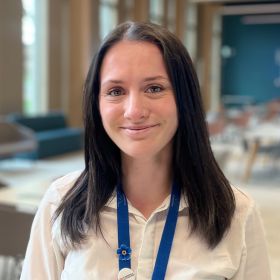
Beccy Owen
Author
Beccy Owen is a PhD Researcher at the University of Warwick, exploring how tau pathology disrupts neuronal ion channels and brain network activity in Alzheimer’s disease. As part of the Midlands Integrative Biosciences Training Programme, her work uses electrophysiology to better understand the molecular drivers of neurodegeneration. Originally from the Welsh countryside, Beccy’s passion for dementia research was shaped during her postgraduate studies and through personal experience with a family member living with the condition. She will be sharing her journey, insights, and lessons learned throughout her PhD here on the blog.


 Dr Becky Carlyle
 Adam Smith
 Dementia Researcher
 Ajantha Abey
 Nature Careers Blog
 Dr Sam Moxon